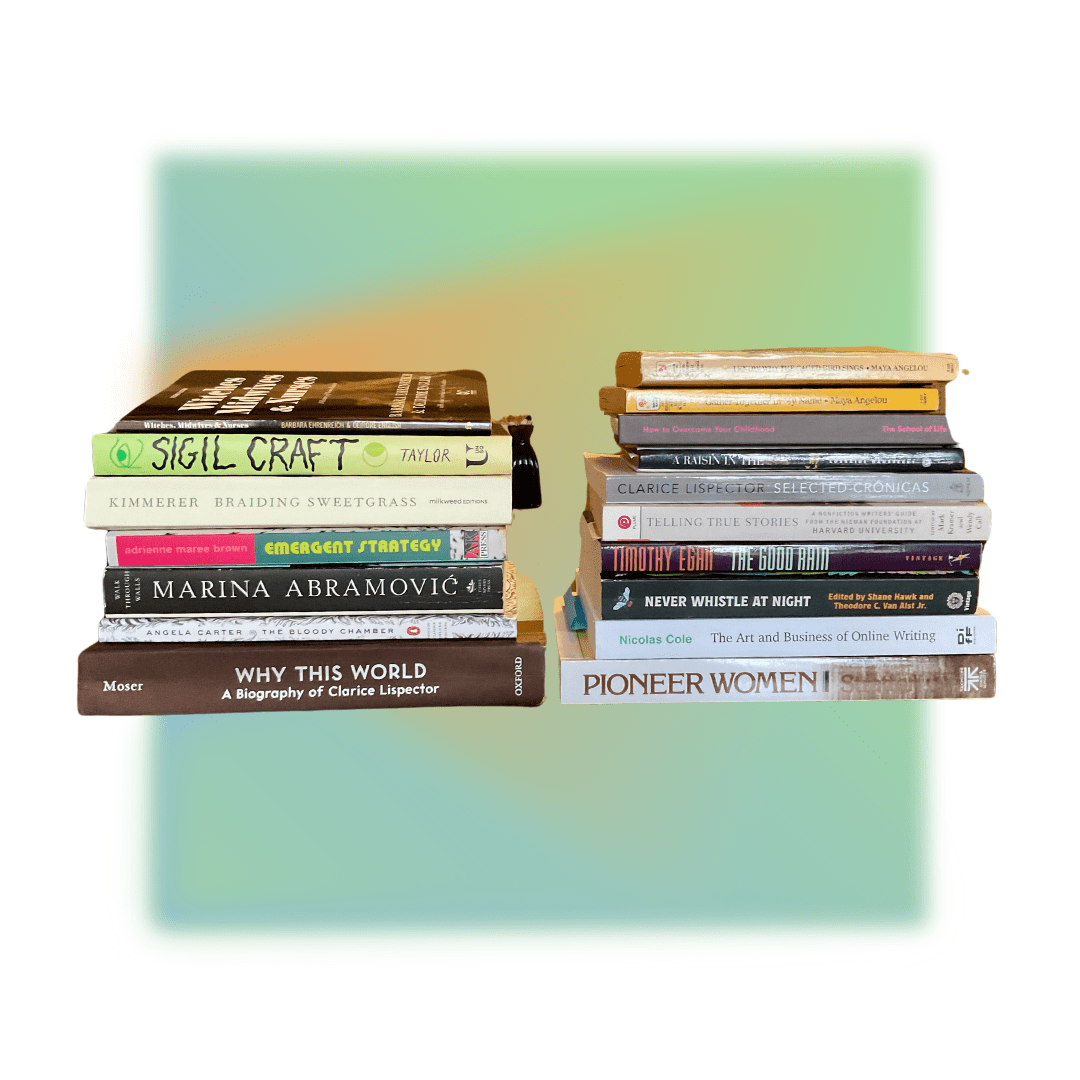
Part 1 of some of my favorite and not so favorite books, short stories, essays and more
I didn’t set out to make 2024 my year of reading – with some checklist set in the background of my yearnings to be absorbed in story, play, rhythm and rhyme, but I ended up with a healthy list of books read anyway, and want to share them here.
This stack of books, both old and relatively new, moved, motivated or (occasionally) irked me. I don’t comment on each book in this list, but I try to put together thoughts on work that generated some sort of feeling or response. It felt like a fun practice to go back and see what I thought the author was getting at. Did I pick up what they were putting down? I certainly hope so.
Here’s to reading in 2025.
Fiction
Florida and Fates & Furies, Lauren Groff
I am not particularly charmed by bestsellers. I’m no snob, but in my practical, hands-on, reading experience, these books, often shiny with mass appeal, rarely jive with my personal taste. I’m sad to report that this is the case for Lauren Groff’s work. While she deals in her character’s complex lives – that is, the drama of their surface level interpersonal scrapes, I rarely found their interior worlds compelling or worth reading about. That said, Florida is more generous in emotional latitude – offering portraits of people who have fallen from grace into poverty, lack, loneliness. In Fates & Furies it becomes hard to believe that Groff liked the characters she wrote into being, and because of that, they are written in ways that keep you at a distance – even though the story is about marriage and all its complexities. The characters are narcissistic and a myopic, with only narrow, unrealistic views of their talents and strengths. On the one hand, this type of portraiture is likely a realistic one – and for that, I praise Groff for her steady hand in showing us characters who resemble our ugliness and blandness without the urge to back off.
The Bloody Chamber, Angela Carter
The Madonna Secret, Sophie Strand
Sophie Strand’s brilliance is what led me to Substack. Her depth, humor and vision charmed me – even through social media captions, to a more thorough yearning for her work. Discovering that she also wrote long-form nonfiction personal essays and books warmed my 2024. In The Madonna Secret, Strand envisions a radical, earth-centered journey – one as lived from the first person perspective of Mary Magdalene, or Miriam. Strand’s tale shows the force, the unpolished and untamed energy of Yeshua (Jesus) as he splits from his cousin, Yochanan and his teachings, but is continually led astray by his ego and the influence of Simeon (Peter) at the chagrin of Miriam. Ultimately, it is a beautiful unfolding epic – concerned with not only an enactivistic style of being and religion, but threaded with a soul-romance between Miriam and Yeshua. Strand’s writing is luscious, philosophical and deep. The Madonna Secret is in my top five books of 2024.
The Nightwatchman, Louise Erdrich
Never Whistle at Night (Multiple Authors)
This collection of “Indigenous dark fiction” took me a second to get into. Not because the writing wasn’t up to snuff, but because I struggle at any whiff of straight forward horror, which the first stories of this anthology excel at. Each author brought to bear varying degrees and flavors of horror — from bodily distortions, mythical harbingers of doom, to the lasting, existential terrors of colonialism, blood quantum purity tests and more.
The story that crumpled me into tears still was Kelli Jo Ford’s “Heart Shaped Clock”. It’s funny how fiction from a complete stranger can have you thinking about people you know and love. Throughout Heart Shaped I struggled to come to grips with the reality that the protagonist, Joseph, was not in fact my brother. Even though his struggles were likely very similar. Even though my brother hasn’t killed anyone (that I know of). The combination of Ford’s exquisite portrait of a sunken heart in a broken man navigating his wants for love and redemption was lethal to me. A sample:
I shouldn’t have had one ounce of hurt left when I was led into the courtroom and saw Mom sitting behind the prosecution. Some days I swear I could feel her eyes burn through me like dry ice, not that I warranted any different. She and her sisters passed wadded-up Kleenex back and forth until the district attorney apologized for getting so specific about what could become of the human body. Then they got up and left one by one. After that, the only thing giving Mom any shape at all was the bench she sat on and the clothes she wore, still pressed neat as could be. There’d be no tearful embraces of the Hollywood sort, I knew. The heart is fucking gristle. The more you try to chew through it, the bigger it gets.
Ford chews through to the tendon on this one, but there are several other honorable mentions, including: D.H Trujillo’s “Snakes are Born in the Dark.” Shane Hawk’s “Behind Collin’s Eyes,” and “Quantum,” by Nick Medina.
Complete Stories, Clarice Lispector
I write more about Clarice’s work in the Essays/Collection section, and have written my own essay to the lesson I’ve learned from Clarice as a writer in an essay published earlier this month.
Non-Fiction
A Fever in the Heartland, Timothy Egan
Once again Egan pulls at the troubled hem of history, and in Fever he investigates the story of how one woman (on her deathbed) took down the second resurgence of the Ku Klux Klan in Indiana.
1. All God’s Children Need Traveling Shoes, 2. Gather Together in My Name, 3. Heart of a Woman, 4. I Know Why the Caged Bird Sings, 5. Singing & Swinging, Maya Angelou
What more can be added to the conversation about Dr. Angelou and her writing? Like many little white girls raised in Kansas City suburbs and in the mainstreaming period of Black consciousness-raising of the 1990s, I read I Know Why the Caged Bird Sings in grade school. I remember the book impacting me deeply, but I believe I held onto details that felt more “warm and fuzzy” as I didn’t fully understand the idea of “Black consciousness”. The ultimate project of Angelou’s oeuvre is the developmental unfolding of one Black woman’s life – her artistry, her survival, her kinship bonds, her travels, and her romantic and familial relationships. In rereading Caged Bird, I am reminded that this book is the first time I encountered Black suspicion of white people. And until I read more about Black political organizing drawn from the works of figures like Marcus Garvey, Malcolm X, and Maya, I had no true understanding of why this suspicion existed. This is, in part, the reason why Maya’s work is so important – it is a “show-don’t-tell” introduction to developing a political and ethical compass.
While much of Maya’s later autobiographies center around her development as an activist, there is so much more to her tales – including how she saw herself as a woman in the world. She learns much of this from jobs – including acting, cooking, and sex work. But she also absorbs many lessons from her mother, a matriarch who lived fiercely and freely. In one of my favorite passages of Gather Together in My Name, Maya’s mother has this to say:
“Baby, Mother Dear’s going to tell you something about life.”
Her face was beautifully calm, all traces of violence lost.
“People will take advantage of you if you let them. Especially Negro women. Everybody, his brother and his dog, thinks he can walk a road in a colored woman’s behind. But you remember this, now. Your mother raised you. You’re full-grown. Let them catch it like they find it. If you haven’t been trained at home to their liking tell them to get to stepping.”
Here a whisper of delight crawled over her face “Stepping. But not on you.”
“You hear me?”
“Yes, Mother. I hear you.”
Braiding Sweetgrass, Robin Wall-Kimmerer
I came to Robin Wall-Kimmerer’s work the long-way, as I often do. I am a “late-blooming” to some cultural creations, and while I felt late to the party on Wall-Kimmerer’s work, I still relish how I got there. Hold on to your hats, y’all, because this is a bit of a wild story.
This past summer I took my epic road-warrior journey from Spokane, Washington to my hometown of Lawrence, Kansas. I wrote about each leg of the journey there. It was not only a bodily geographic convergence, but a spiritual one as well.
While staying with a truly lovely woman in Lawrence I decided to get a color energy reading from none other than Allison Kaylor of Moon Nectar Apothecary (known as The Holographic Energy Report here on Substack). There are so many things Allison got right in our conversation. From my interest in and exploration of femicide, to matrilineal psychic connections, to a very specific happening in my family, Allison, in so many words, showed me she was the real deal. To top it off, she riffed on an intuitive hit: “braiding hair” and a parallel point regarding a tribe, or something related to North American indigeneity. There was no cultural appropriation bullshit, just a hint – lingering there.
Days later, my host is hanging out on her couch, reading Wall-Kimmerer’s Braiding Sweetgrass. I had always had Braiding in the back of my brain, knowing it had the power to galvanize and change the way I see the world, but had never taken the step to read it. At my host’s urging, I went downtown and picked up a copy at a local outdoor shop. Trading her copy for my own, I sat with a cold drink on the shop’s back patio and luxuriously poured over, page after page, Robin’s astute and brilliant “two-eyed”seeings. Early on a line pounced out at me, nibbling at the nape of my neck – drawing the fine hairs upwards in electric recognition:
“There’s such tenderness in braiding the hair of someone you love. Kindness and something more flow between the braider and the braided, the two connected by the cord of the plait. Wiingaashk waves in strands, long and shining like a woman’s freshly washed hair. And so we say it’s the flowing hair of Mother Earth. When we braid sweetgrass, we are braiding the hair of Mother Earth, showing her our loving attention, our care for her beauty and well-being, in gratitude for all she has given us. Children hearing the Skywoman story from birth know in their bones the responsibility that flows between human and earth.”
In Lawrence I was reminded of how deeply and sensually tied I am to the people, animals and earth of the Kaw Valley region. And while I learned all about earth in Wall-Kimmerer’s book, it felt like divine intervention that I was shown her work. Braiding Sweetgrass is in my top five books read in 2024.
Walk through Walls, Marina Abramović
A re-read of the life and times of the baddest, most hardcore godmother of performance and body-based art. Read this if you’re struggling with your confidence as an artist – it will invigorate and shake you up.
Essays/Collections
Croñicas, Clarice Lispector
From my most recent essay on the genius of Clarice Lispector: I remember catching Clarice Lispector’s feline gaze at a bookstore in Portland, Oregon. That gaze, stamped on a tome of a book, eyes unperturbed, was a glance as alive now as then. The glance, her gaze, like the simple workings of a spell, brought me over to the display to open the book and sink in.
What I read initially confused me. There was something simultaneously gauzy and sharp about her diction, the translation suffused with Clarice’s essence and the translator’s. Whether her words make sense to me in the way they are meant is for another discussion, but it wasn’t until years later that that gaze finally got me.
I started with that very same collection of short stories and have since wormed into her collection of Cronicas, a distinctly Brazilian genre of celebrity and celebrity-adjacent missives that are non-standard in form and were read in local newspapers. After that, I moved on to Benjamin Moser’s biography and am getting to know the Jewish women who fled with her family from Ukraine – through another’s words—her world, her loves, her ambivalences.
Read the rest of the essay here.
Essential Essays, Adrienne Rich
From a Substack note, written while reading Essential Essays: Taking my sweet time reading the Essential Essays of Adrienne Rich, mostly because her writing is so delicious and incisiveness. I have many marked and tagged pages, but this passage from the article she wrote regarding her refusal of the National Medal for the Arts is why Rich was a real one. She of all people truly understood that art, that includes writing, is not merely for the sake of decor and artfulness, but collective effort, “reborn hourly”. We need more wisdom like hers.
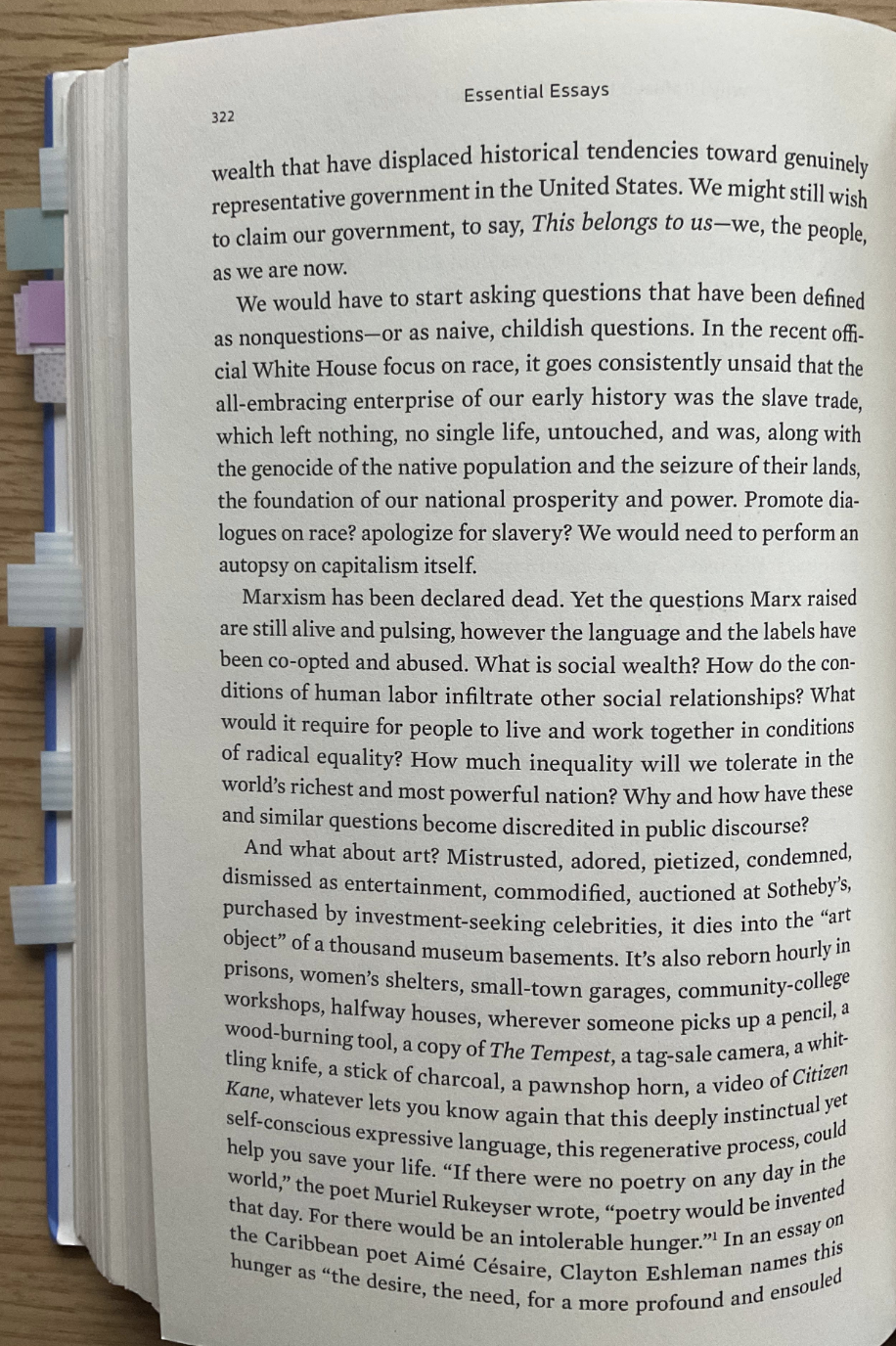
I maybe took Adrienne Rich a little too lightly at first. Again, I read her work early – understood her firstly through her “Diving Through the Wreck” poem, simply understood to be a poem about marriage and divorce. Essential Essays does any of us with a surface level understanding of Rich’s work a great justice. Rich’s words sizzle and sear the page, and like Angelou, we get to witness a complex mind develop wisdom around race, gender and the systems that exploit these identities.
Not only are observations shared, but theories developed, including Rich’s emphasis that heterosexuality is impressed upon and the only societally acceptable option for women. Compulsory heterosexuality may seem like a widely adapted term now, but at the time of Rich’s writing it was not only radical, but potentially heretical in the church and state configuration of “man + woman = love”. What impresses me the most about RIch is that she isn’t just theory and talk, but praxis and practical application. Her refusal of the National Medal for the Arts and her subsequent explanation is the most lucid and pressing argument for the liberation of art from the confines of capitalist commodification.
Telling True Stories, Kramer et al
World of Wonders: In Praise of Fireflies, Whale Sharks, and Other Astonishments, Aimee Nezhukumatathil