In cities, there is so much waiting.
For the train. For a friend to cross town. For the family ahead to pick up the pace. For another movie set to wrap. For the sun to sink behind downtown’s Stonehenge of high rises, and for the coolness of night to settle.
Cities can make us nervous. The loud cracks, bass vibrations, screaming, and car alarms demand a thickening of one’s cortisol reserves. In the first months in a new city, eye twitches and insomnia often settle in. The brain asks: what can be tucked away as part of some unseen schema—there, but unnoticed? Yet a twitch, a compulsion, still resides like a cool shadow on one’s shoulder. For most of us, much in our view must be elided and forgotten, or, in the words of James Elkin, “…seeing is too full, too powerful to indulge in without careful rules and limitations.” (Elkins, 1996)
Summer, 2008 in New York was hot. New to the city, I took the subway everywhere. The repeated journey from the A to the C line into Midtown for work at a creative, but minimum-wage job, left my last nerve frizzled. In my frenzy to work, my gaze drifted to the walls – a space cities claw away at with advertisements. On the way to earn money, the subway reminds us how we might spend it: Bottega Veneta! Target! New York Symphony season tickets!
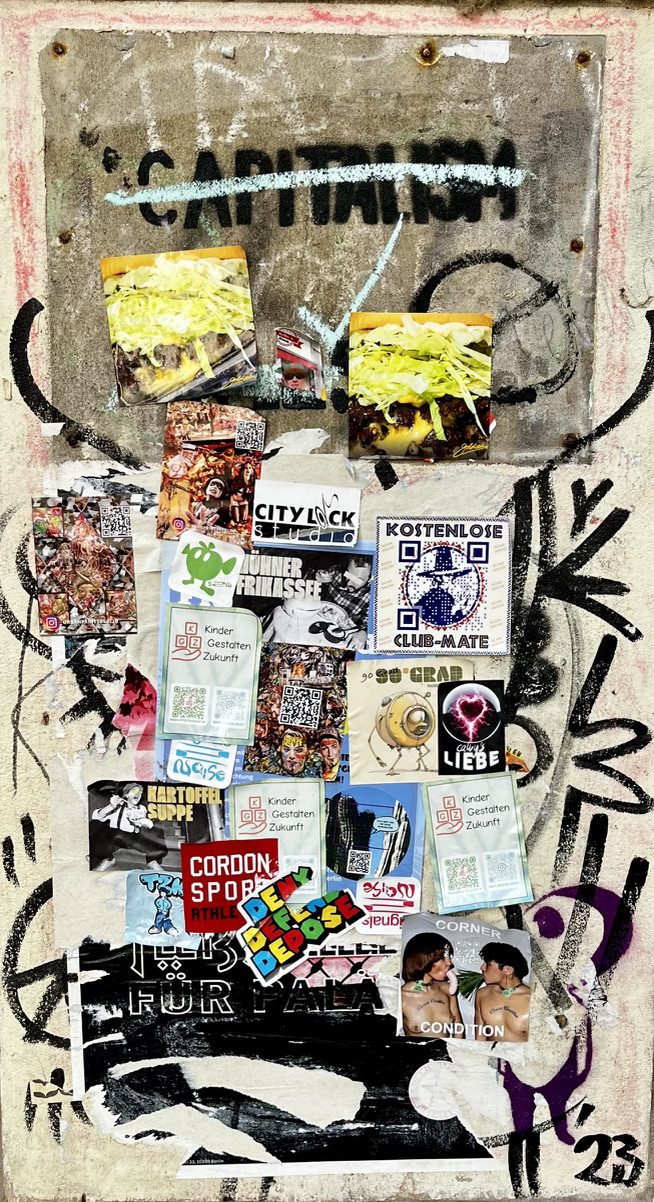
Over time, these layered posters launched in 3D for me, sitting in stark relief and forming a kind of urban palimpsest. The NYC subway system has existed for roughly 120 years—imagine the onion-like layers of residue left on those boards. Perhaps only the nervous, simultaneously bored “artists” who carefully, or not so carefully, tear away strip after strip of advertisement have truly considered this. This tearing, layering, and re-tearing has resulted in a type of Accidental Street Art, art that emerges from restlessness, boredom, and tension. It is through these repeated actions that a subconscious art form evolves.
These artists are not traditionally trained. There is no MFA in wall trash art. Just urbanity-induced neuroticism and a dash of rebellion. The twin desires of destruction and creation are the kindling for these compositions.
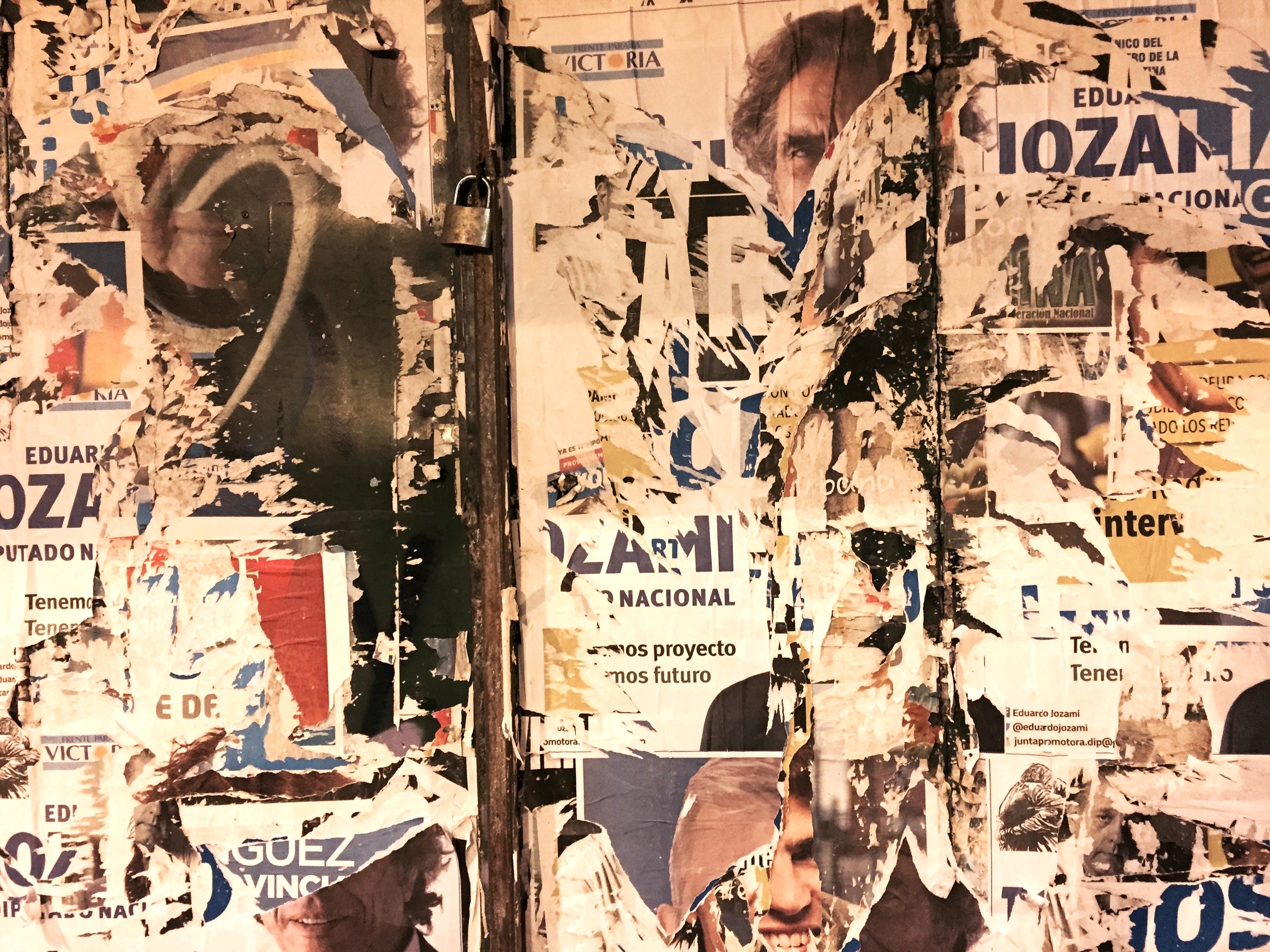
New York’s Accidental Street Art (ASA) isn’t even the best. Some of the best open-air trash art exhibitions, aka ASA, can be found in Hyderabad, Singapore, or Berlin. While there is a rich tradition of examining nascent art forms, sometimes even ironically, this essay posits a genuine, sustained observation of Accidental Street Art, across cities and countries, over 18 years.
What are the characteristics of accidental street art?
Created by many, over time
Accidental street art is a collaborative form, built on the fly. Contributions come across social and demographic strata—young or old, commuter or local. Here, the preciousness of a single artist toiling in their studio is irrelevant. ASA is characterized by secretive action, commonplace trash, and the visible scars of time. Most contributions are made individually, in passing, by countless hands. Unlike AI-driven art, which burns with the heat of a few hundred acres of forest, ASA pulses with the warmth of the human palm—the forefinger and thumb delicately tearing away the commercial detritus of our society.
Marked by decay and ruin
Cities are sites of labor and conspicuous consumption. Every commute to work and shopping exposes us to roughly 100 ads—not counting those on our phones. Capitalism’s lie is that what’s sold to us offers immortality, a fresh spirit, face, and body. ASA exposes this lie, as advertisements decay and degrade before us. Commuters tear at the fairytale of late-stage capitalism, revealing that the commodities we buy are easily discarded, their wrappers scattered and repurposed around us. ASA, even without intending to, disrupts global homogenetic culture (GHC), or the increasing sameness and flattening of culture we increasingly see everywhere.
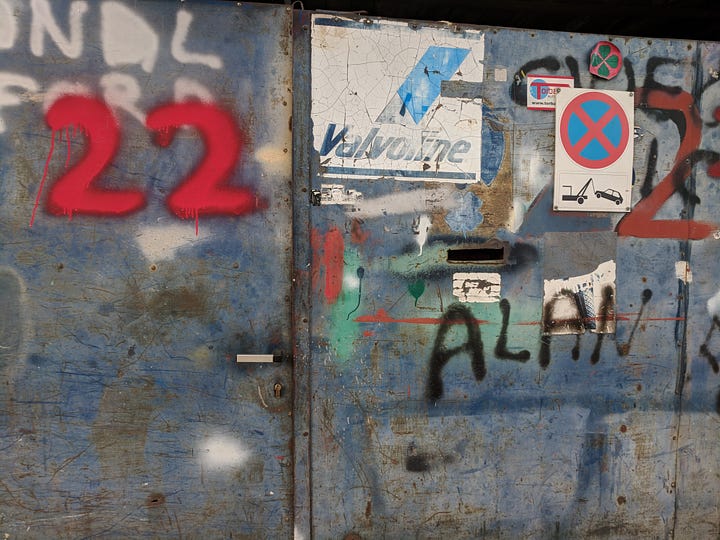
Ephemeral
There is no Mona Lisa of accidental street art, no fee, no glass case, no guards. Ephemerality is a key characteristic of ASA, and it is meant to be created, destroyed, and reinvented continuously. No single composition is permanent; its existence is marked by transition and change. And while there is no “grandness” to behold, there is an awe one may experience by seeing the work of invisible hands – the fast and vast etchings of the body electric.
Public and communal
Each ASA piece is a product of its community, taped and torn in public, for all to see. Many people disregard these works, but they are there, chronicling public life through their creation and dissolution. The site of these works occurs at train and bus stations, utility poles, bike racks, and park signs. This art is not “nice” and is not trying to please. Like the public that creates it, a mix of emotions can spur the “artist” to mark shared space.
Unofficial, anti-institutional
ASA exists outside institutions and their support. It is outsider art at its most extreme—not even intentionally made as art. Through observation and composition, we witness a confrontation between consumers, artists, and society, free from institutional mediation. As such, ASA is a marker of its community, not its institutions, which reflect varying degrees of power, influence, and access.
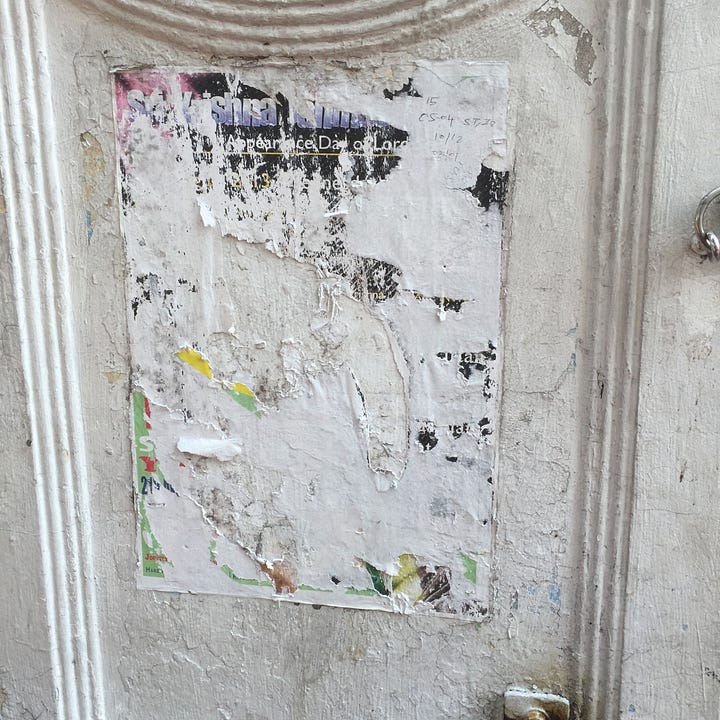
An Antidote to Digital Life
ASA is an antidote to our digital life. It is a collection of things, a collage of things. Like us, it is drawn, pinned to the earth, held to the earth with gravity – the earth’s loving embrace. It enters our vision as a call and response to light. It is material, and as such, it is arrestable1 (Han, 2022) and an antidote to the immateriality of our lives. In ASA we can sink into mystery and an aura that is inescapable and real.
What are its antecedents?
Collage
Collage began as a recognizable art form with the Surrealists, closely paralleled by Dada’s photo montage. Collage is one of the strongest democratized art forms, with a flat educational hierarchy and easy entry. Collage is also devised with other’s second-hand paper ephemeral or photography, including the loud advertisements and proclamations of magazines. The collagist intentionally subverts the advertisement or image’s original intent. Collage accomplishes this subversion via several tactics, including but not limited to juxtaposition, tearing, inversion, use of negative space, and more.
Street and public art
Accidental Street Art is the natural descendent of intentional street art, which includes anywhere from sticker art, graffiti, train monikers, and wheat paste-ups. ASA compositions often combine all of the above, with an emphasis on “accidental” – there is no intentional composition of the whole – only individual contributions that serve the evolving piece.
Like the inevitable rivers that flow through these cities, there is much to contend with: does art begin with an intentional act? Does beauty have to be purposeful? What can we learn from the flavors and exposures of Accidental Street Art? And like the horizon with its gray glove-like hovering clouds, there is not one point for the eyes to settle home on.
ASA is the outsider
the drifter
the lone,
young
bent over with age
patina of a person
The place:
mirrored platforms,
where the wind conjures
speed
and the exhales
of a terrestrial breath.2

The Anti-Misogyny Club has published my Missing and Murdered Indigenous Women, Girls 2S essay, and you can read all about the underpinnings of this terrible phenomenon and what Washington State has been doing to mitigate it.
Stayed tuned for the publication of my essay on the Jewish Brazillian writer Clarice Lispector in the Dandelion Revolution Press.
1 See also Walter Benjamin’s concept of the aura of an artwork
2 Yes, sometimes I will write you poetry, too.