How femicide, environmental violence, and the backlash to women’s liberation shaped a deadly era in America
Years ago, David Lynch brought the show Twin Peaks back from the dead. Affirming a threat hurled by one of its main characters that we’d see him again — clambering through the unsoothable dread of small town life and death in the Pacific Northwest. Making good on his promise made Peaksies mighty glad, and they expressed an excitement they hadn’t felt since their first viewings. As the fervor of the third season’s drop grew to a Ponderosa Pine pitch, I began to question my love for this beloved show. Through the fictionalized mystery, drama, and occasional goofball antics of the show’s characters, we had, as fans, come together to celebrate a show predicated on a girl’s molestation, rape, torture, and murder. This long and searching arch, first born out of a love for Twin Peaks, turned to an examination of women’s murders — fictionalized or otherwise.
I began to research femicide, the act of killing women because of their gender. I found very little in the way of legal frameworks, definitions, and advocacy in the United States. Femicide does not have a legal definition here, and it is rarely, if ever, considered a hate crime. Men kill women with impunity, and the subject of such terror has made its way into an entire media genre. When I began researching and writing about the topic, I started a semi-public conversation. I dug deeper. I later found out that an assumed suicide in my family had likely been a murder — my great aunt was snuffed out by a “town founder” in the wilds of Eastern Montana. There are an unimaginable number of similar stories, families who continue to cling to stories unsolved. Their grief carries them through time, in an achingly slow way, like treading upstream through a mighty river.
The more I talked about the topic of women killing, the greater an echo followed. The response wasn’t a precise reflection, though; it was wobbly and sensational.
It was asking about true crime.
Was I a fan?
Did I enjoy watching television shows and drooling over podcasts detailing the vicious murders of a predominantly female demographic?
I came to really loathe the topic and the genre. I found that those who “investigated” these murders were more concerned with the “how” and every gory detail rather than the *why*. I have, from the beginning, been curious about the why.
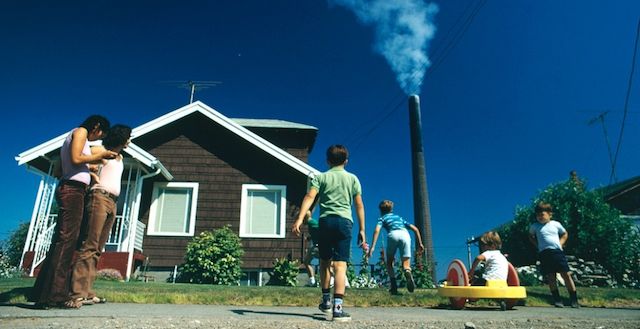
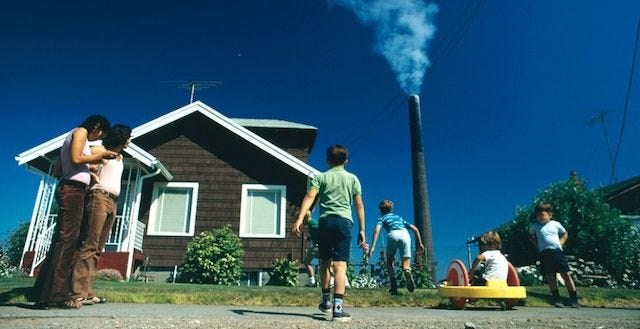
So when I heard about Carole Fraser’s book Murderland (2024), I felt like a generous thread had intersected the nest I was building. Fraser’s thesis is brilliant and provable: the unfolding of extractive and poisonous industries in the Pacific Northwest has not only made serial killers of corporations, but also of men who have killed in the most vile and repugnant ways. Fraser posits that the killer’s proximity to Tacoma, Washington, and its capacious plumes of arsenic and slag byproduct led to a generation of unrepentant killers.
Pollution and aberrant behavior: where science ends
Fraser’s base is scientific. She presents irrefutable evidence that the link between aberrant behavior and industrial pollution is clear. While she relies heavily on reportage, her writing also leans into memoir and literary nonfiction. As a reader, but also as someone who wants to understand the material circumstances that lead to human behavior, I found Fraser’s evidence compelling. As someone who wants to know what leads men to kill women, I saw her argument novel and worth deeper consideration.
Murderland’s Oversights
I also found it half-formed. Fraser argues that we are a product of our times and our environments. She excels at linking the real world of exploitive industries, their poisons, and higher crime rates and incidents of violence. Unfortunately, she fails to provide explanations for this behavior beyond a reductionist argument of particulates, body, and brain. Millions of people were exposed to these pollutants every day, and over the course of more than a hundred years. As Fraser elucidates in Murderland, the height of these terrible crimes is 1974, plus or minus a few years. Why did only a select few step into the shadows to repeatedly and cruelly extinguish life, and why not others during this time?
What was it about the environment of the 1970s that led to an explosion of violence against women — more so than any other decade? What else could have contributed to this behavior? These questions disturbed me throughout Murderland, and I wondered why Fraser didn’t try to answer them.
Backlash to women’s liberation
The women’s liberation movement of the 1970s revolted against the staunch conformity of the 1950s. It was this movement that patriarchal culture struck back against with a wave of brutal, often spectacular violence against women—embodied in figures like Ted Bundy and the Green River Killer—revealing a tense backlash between liberation and misogynistic violence. In fact, Diana E.H. Russell, the feminist thinker who is primarily thought to have coined the term “femicide,”1 argued that state and individual violence against women is a form of terrorism. I argue that Fraser’s point, suffused with the gains made for women during the 1970s, led to a significant cultural and physical backlash, perpetuated by serial killers and the media’s coverage of their exploits.
In Fraser’s book, passages describe what women were wearing and where they were going — very few mark who they were. Fraser often recreates the media’s appetite for titillating details of the killers’ lives, in some ways humanizing them more than their victims. It is not until page 321 of Murderland that she describes anything resembling a response to the violence, highlighting a Take Back the Night March in Seattle, 1984. I find it hard to believe that women weren’t fighting for their lives during and before this time.
In fact, they were, in a variety of ways.
What gains did the women’s liberation movement achieve, and how did backlash and bad actors seek to erode them? Below is a timeline:
- Title IX (1972) – prohibited sex-based discrimination in athletics and higher education
- Equal Rights Act (passed Congress in 1972) – the legal affirmation of equality between the sexes, failed to gain full state ratification in 1982
- Roe v. Wade (1973) – guaranteed the right to bodily and reproductive autonomy for women
- No-Fault Divorce (1969-70s) – lowered the bar for women to leave bad marriages
- Ms. magazine debuts (1972) – brought feminist concepts further into the mainstream
- Deep Throat released (1972) – pivotal media in the development of pornographic culture, later revealed the abuses that actor Linda Lovelace suffered in the film
- Hustler magazine debuts (1974) – a more graphic and politically charged form of media contribution to pornographic culture
- Equal Credit Opportunity Act (1974) – women were able to secure lines of credit without the permission of their husbands or guardians
- Pregnancy Discrimination Act (1978) – job force protection against firing related to pregnancy
No other period in American history had women sought and won so many freedoms. This work was not done from the sleepy confines of the home, but in the streets, united with other women and allies. It was an imperfect movement, but what it destroyed and created in its wake revealed the last gasp of a period marked by particular suppressions of women. Those gasps were mighty and swung far across the US in the form of domestic abuse, murder, dehumanizing pornography, and illegal discrimination. The response to women’s freedoms born in the 1970s was disproportionate and punishing, as if each step forward meant a swift kick back into the dark ages.
Murderland review: what Fraser doesn’t name
3/4 into Murderland, Fraser finally hints at an articulation of this violence when she mentions “femicide”, a phenomenon pinned mainly to gender based violence in Mexico. It was disappointing to see it take her that long.
We are not exceptional in the degree of violence towards women in this country. As Fraser shares with her readers over and over again throughout her book, we make serial killers and murderers of women in the United States with startling frequency. Fraser missed an opportunity to acknowledge this epidemic in the United States and initiate a conversation about its implications. Most of Murderland focuses on the individual murders of women murdered in the United States; it isn’t until page 353, when the author mentions femicide, that she articulates the systemic reasons for violence against women. The Mexican victims are a faceless whole, whereas the victims of the north have names, eye colors, families, and distinct clothing. In Mexico, Fraser sees the system these women live in as predatory and scary; in the US, they are simply the unacknowledged consequences of male and capitalistic violence.
You may be asking yourself, why does Fraser need to focus on women’s freedom in her book, when her thesis revolves around the corporate greed and negligence that led to the poisoning of our people and the creation of serial killers. I believe Fraser’s goal is humane, even if it’s communicated through bared teeth: she wants the liberation and freedom from harm for all people. I admire this aim, but beyond those who lived within a five-mile radius of smelters and slag pits, we owe an explanation for the myriad women murdered by these vicious criminals. Even in her anger, I know Fraser wants to honor the land we live on here in the Pacific Northwest. She wants us to do better by our communities, to pursue a better world. Part of that better world is examining closely who is disproportionately harmed by these pollutants and human killers.
Environmental justice requires naming harms
Environmental justice, which I believe is what underpins Murderland, is not simply removing physical (chemical) actors in an ecosystem; it is acknowledging who is harmed most by repeated and sustained degradation. And in so many cases, across the world and in the United States, women, and more specifically poor women,2 are impacted the most. Whether through displacement, brute extraction and disruption of local economies, or the fracturing of an entire system of care that women across the world uphold — to our detriment or not, we must name what is before us and ahead, and in the naming, we have the best chance of protecting the most vulnerable amongst us.
1 Femicide: The Politics of Women Killing, Jill Radford & Diana E.H. Russell, 1992.
2“How gender inequality and climate change are interconnected,” United Nations, Apr 2025.