Redirecting Sensual Energy
Saying goodbye to a fairly affectionate long term relationship, one that came with a dog bursting with energy and a genetic instinct to trust everyone now means redirecting sensual energy to everything else. Here’s how that’s shown up for me:
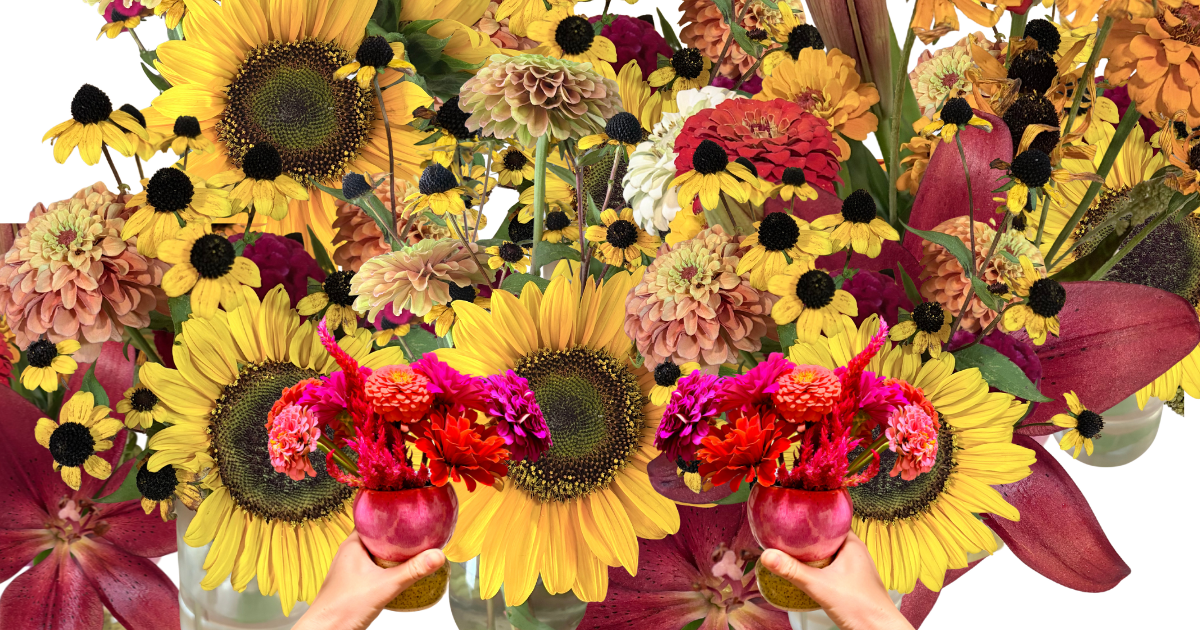
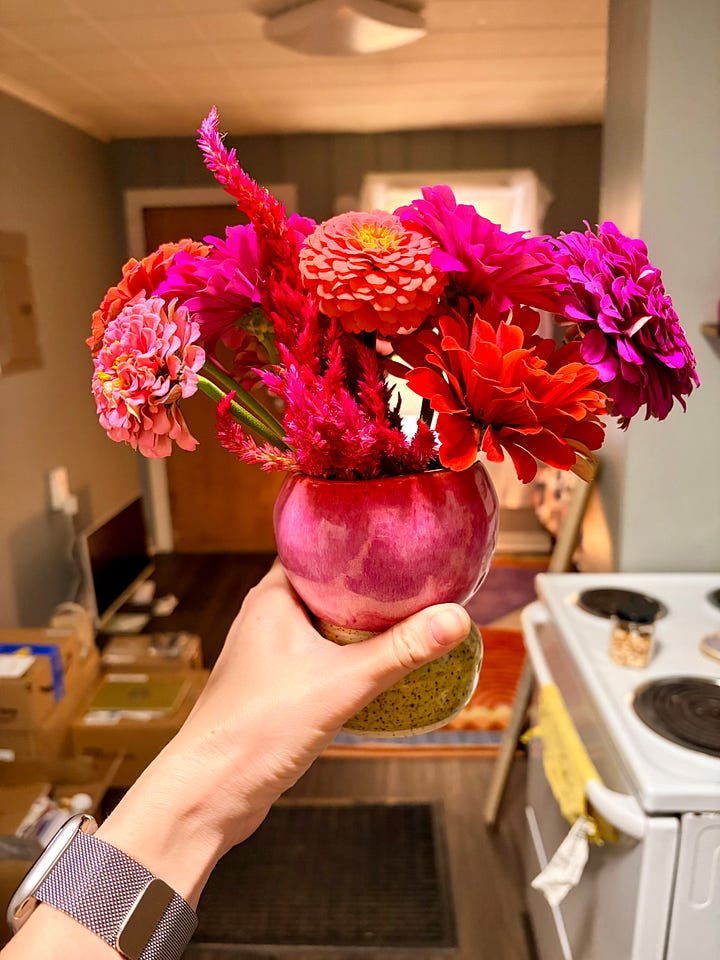
Every week I buy myself flowers from the Lawrence Farmer’s Market. Sometimes I go for herbs, the occasional brown paper sack of cherry tomatoes or pearl onions, but I always go for flowers. Deciding on bouquets is tough: there are a variety of vendors with different approaches to arrangement, color pairing and price.
I’ve sampled a few different stalls, but am continuously drawn to the deep, saturated, nearly explosive-with-brightness bushels. I then bring them home, and separate them into smaller vases. They are all native to the area, too: Columbine, with its bells and bends, velvety cock’s comb, solar-sunshiney Sunflower. They are my little charmers, a reminder that we, I, deserve beauty.
Then there’s fresh dill on eggs. Eggs heaped on fresh local bread. Fat slabs of butter heaped on said bread. A fat-bottomed dash of bold, citrusy sumac. Deep and dastardly moan. Big Time Sensuality on my plate. I taste the tip of my finger where a melty drop of butter clings. This is living.
Two gigantic bear hugs in one day. A hey you, then generous, sustained embrace. Small chat post-rainfall and lightning stretches. Next I see an old friend at the grocery store – a rewinding of the clock arms, time travel, a recognition that softens eyes and another sustained and gentle hug. The graceful reentry back home is made all the sweeter by those who love so easily.
Learning About and Writing Lyric Essays
I’m MFA-free, as in most of my writing is a self-taught instinct with some formal education tapped on top and mostly, consciously, forgotten. No writing robots here, just working class ones reared in the world of things that fall apart. I’m not willfully ignorant of forms and have been overjoyed to discover that the way that I write, the genre I am most alive in, is the lyric essay.
The lyric essay is a hybrid, experimental form. But that simple sentence still doesn’t do the form justice. To elucidate the genre, I’ve happily turned to the book, “A Harp in the Stars, An Anthology of Lyric Essays,” edited by Randon Billings Noble.
Noble opens the collection with an attempt (the word essay’s etymology). She gives a broad strokes introduction to the lyric essay, some definitions and approaches:
Definitions
Lyric essays have…power to sooth, to harrow, to persuade, to move, to raise, to rouse, to overcome.
They rely more on intuition than exposition.
Loose, but still has the responsibilities of any essay: to try to figure something out…
Lyric essays require a kind of passion, a commitment to weirdness in the face of convention, a willingness to risk confusion.
With these definitions are a number of approaches: the hermit crab, braided, and segmented essay all offer vivid and new approaches to textual exploration – all dealer’s choice. I’m a few essays in, but I’ve already felt something familiar yet fresh. These essays give me hope about the future of reading and writing. The lyric essay is expansive and freeing, and ready for your eyes.
Relearning About Where I’m From
In my first version of life in Lawrence I lived in subsidized housing. The projects, a place called Edgewood at the intersections of 16th & Haskell. Our apartment was on a corner, but that was its only distinguishing feature. It stood in a uniform red brick with four or five plank fences. I can still drive by and get my hands to remember the grip that they once held on the window sill as I snuck out of the house, flying free on my bike through the woods to downtown.
That has been most of my life here. Low-income, working class, scraping by. And that’s why I was heartened to encounter a new exhibit at the Watkins Museum, called ‘Unsettled Lawrence,” which opens up a rounder and more nuanced picture of the place I call home. There are many Lawrences that the Watkin’s proposes, and yet, there is one Lawrence that has stayed unknown, except maybe to the descendants of the city’s East Bottoms, the neighborhood of focus in Rachel Schwaller’s research.
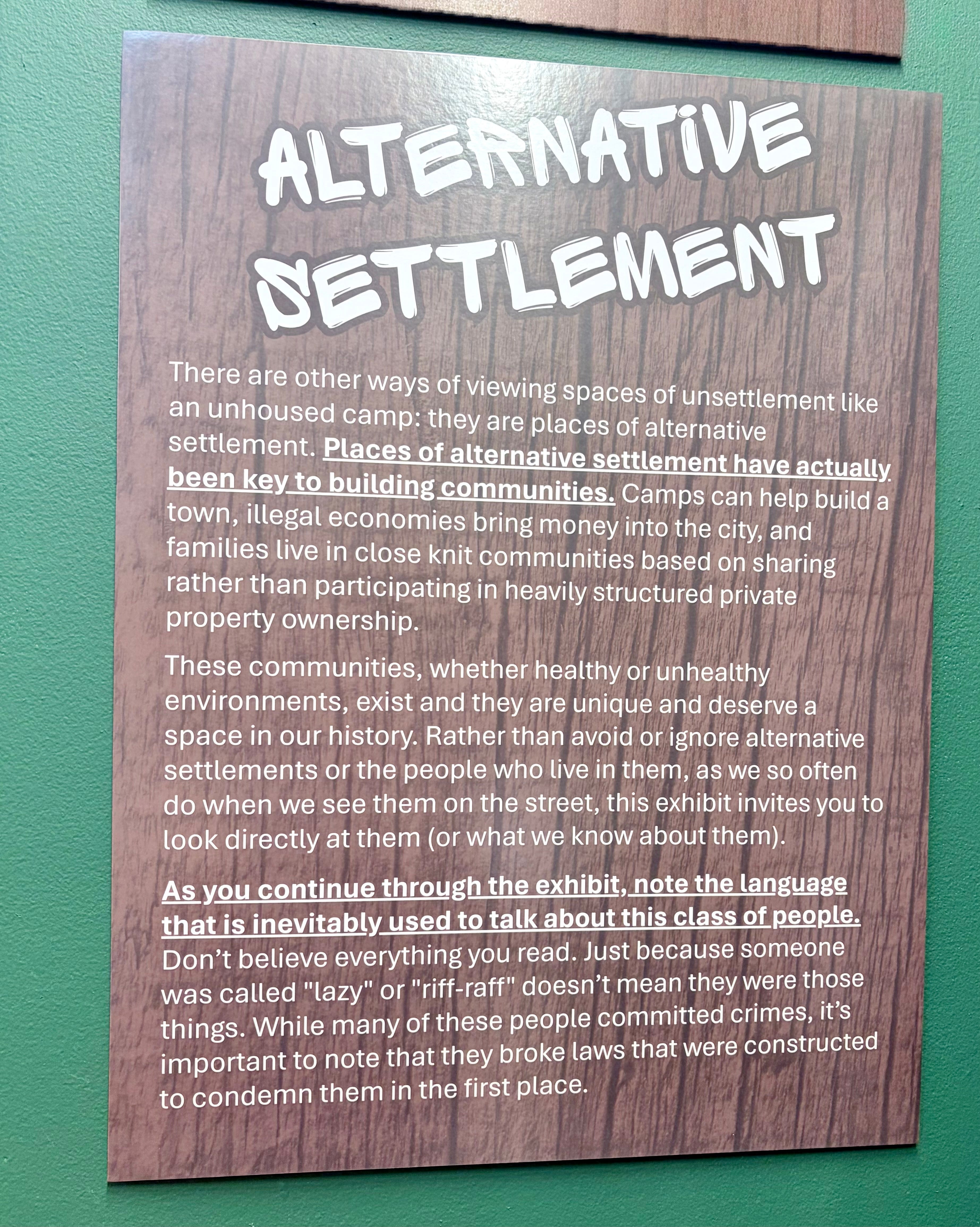
This is an exhibit about race, class, and gender – three factors which often seem overlooked in museum work. I appreciated the careful documentation of oral histories, examples of media bias, and settlement maps.
As someone who tends to romanticize this place, I need to be reminded that young Black boys were often the target of police harassment, that young poor women were cited for vagrancy if they were found walking alone at night by themselves, and that being poor or indigent came with a whole suite of moral classifications – to be poor was to be morally impure and wrong.
The East Bottoms was also a red light district and catered to everyone regardless of religious status or race. It was the only real integrated part of town in the midst of segregation. It ran alternative economies, and as such was often able to front money to the City for its police, fire department and other staff when the folks at the top mismanaged funds. It had its heroes and villains and I’m glad we aren’t ignoring it anymore.
Here’s to tearing tiny pinpricks in my perception of a place – because even though I love it wholeheartedly, I’d rather not love it blindly. Here’s to all who survived the East Bottoms and here’s to all who might not have.