The writer in solitude is a myth. No matter how many deadbolts you have locked on your literal and metaphorical doors, you are a citizen of a creative ecosystem, where all manner of biota flourish or struggle under the material and social conditions of their time.
In the petri dish that is creative culture, you are what you eat: if you spite-read when you follow others, your work will struggle to cast off an aura of ugliness. If you’re the creative cheerleader shouting from the stands and offering high-fives, confused about why people openly sneer at your joy for them, you will be confused by others’ insecurity. Why can’t we all just get along, you ask? Why indeed.
For generations, creatives have considered themselves an exception to capitalism’s extractive sense-making. We want to stand outside time, outside the reality of art as a commodity. But practically speaking, many of us are one TikTok reel away from hefting a sandwich board over our shoulders — offering discounted essays and emoji-and-AI-littered social media posts for a handful of likes and half-scrolls. It can be hard to create in the face of this “gimme” culture with no real response, other than our own, to tell us if we’re on the right path.
On the other hand, when the world seems to value your work, or at the bare minimum, you value your work, and do so openly, you are left vulnerable to the haterade of your supposed peers. What gives? And how does this manifest? Below is just a short list of some of the ways that one might experience our peers’ disdain and jealousy:
- Ignoring your presence in physical spaces, even if you’ve met many times before
- Posting underhanded digs about a platform, process, or piece you are currently working on
- Not engaging your work at all, even if you’re “close”
- Making comments about how you’re so busy or “ambitious”
- Writing about your work obliquely under the banner of literary or artistic criticism
- Sharing flat-out and personally hostile essays about you or other writers (e.g., recent garbage takes on Ocean Vuong)
I’m not against criticism. Literary criticism is a valuable tool to help us sharpen our work, to make it more effective, coherent, and real. But, there is a fine line between critique to improve versus critique to embolden the ego. Not sure how this looks? Let’s take a look at a few historical petty punctures, starting with Roberto Bolaño1 on Isabelle Allende and Gabriel Garcia Marquez:
On Allende: a “scribbler” whose “attempts at literature range from kitsch to the pathetic.”
On Garcia Marquez: “a man terribly pleased to have hobnobbed with so many Presidents and Archbishops.”
Lest you think this is just writer-on-writer crime, here’s another:
Editor Harold Bloom on Stephen King’s National Book Award for Distinguished Contribution to American Letters (2003): “The decision… is another low in the shocking process of dumbing down our literary culture2,” and on Maya Angelou: “Miss Maya Angelou cannot write her way out of a paper bag!3“
So, the history of “criticism” is chock full of peer-to-peer slander, but is also open to the occasional editor and non-writer as well. Sometimes the hater is a “friend,” someone in sheep’s clothing who appears, on the surface, to support your work. These types are only able to engage your work on a surface level and do one of many things, including, but not limited to: projecting their fear of failure onto you, projecting their unfulfilled desires onto you, and perpetuating tall poppy syndrome. No one group of people has a majority claim on hating, but I’ve noticed some patterns:
- Critique stemming from a white supremacist culture of perfectionism. Weaponizing the English language and its grammar to punish writers of color who play by a different set of rules.
- Men who want to cut women down to size. Due to either sheer jealousy or a disbelief that the women they compete with are incapable of embodying genius, verve, and intellectual rigor.
- People whose creative spirits have been so crushed by family expectations or the culture at large, and/or people who have bought into the idea of art as a commodity and contest.
- People who’ve never left their hometowns and, as a result, are big fish in a little pond. This is a particular issue if their hometown is tight on resources for artists. They’re often turned to repeatedly for major public works and have a hard time “passing the torch” or collaborating unless the other is fully “vetted” or has enough social capital.
Being a Hater, and How to Stop
Do you find yourself hate-following, hate-reading, and listening to other writers and artists? Do you roll your eyes every time they roll out a new project? Do you sublimate your jealousy of their work into underhanded digs on social media or behind their backs? Or are you openly hostile to their presence? If you said yes to any of these questions, you might be a hater.
If that’s the case, here are some ways to redirect that jealousy:
1. Use it to fuel you and gain clarity. When you experience a pinch in your heart about what’s on someone else’s plate at the creative table, look to your own meal and use it to inspire you. Better yet, use it to clarify what it is you want.
Example: a friend got a great job in a beautiful city. I was immediately jealous, but after a few conversations with myself, I asked, “What is this jealousy telling me?”. I found out that I wanted the security of a better-paying job and to live in a city with a vibrant arts scene. I later realized that bumping up my pay grade would mean more responsibility, which would ultimately take away other freedoms. I also realized that if I wanted to see more art, I needed to actually commit to seeing more art. Being jealous showed me what I needed and what I didn’t need.
2. Move on. If you have the time and energy to linger negatively on someone else’s work, you may have too much time and your hands, and friend, that likely means you aren’t doing the work you’re meant to do. Have you been saying you’re going to write a novel for the better part of a decade, still haven’t done it, but continue to throw yourself into unrelated and mismatched projects, all the while critiquing anything that flies a little too close to the sun? You might be procrasti-hating4.
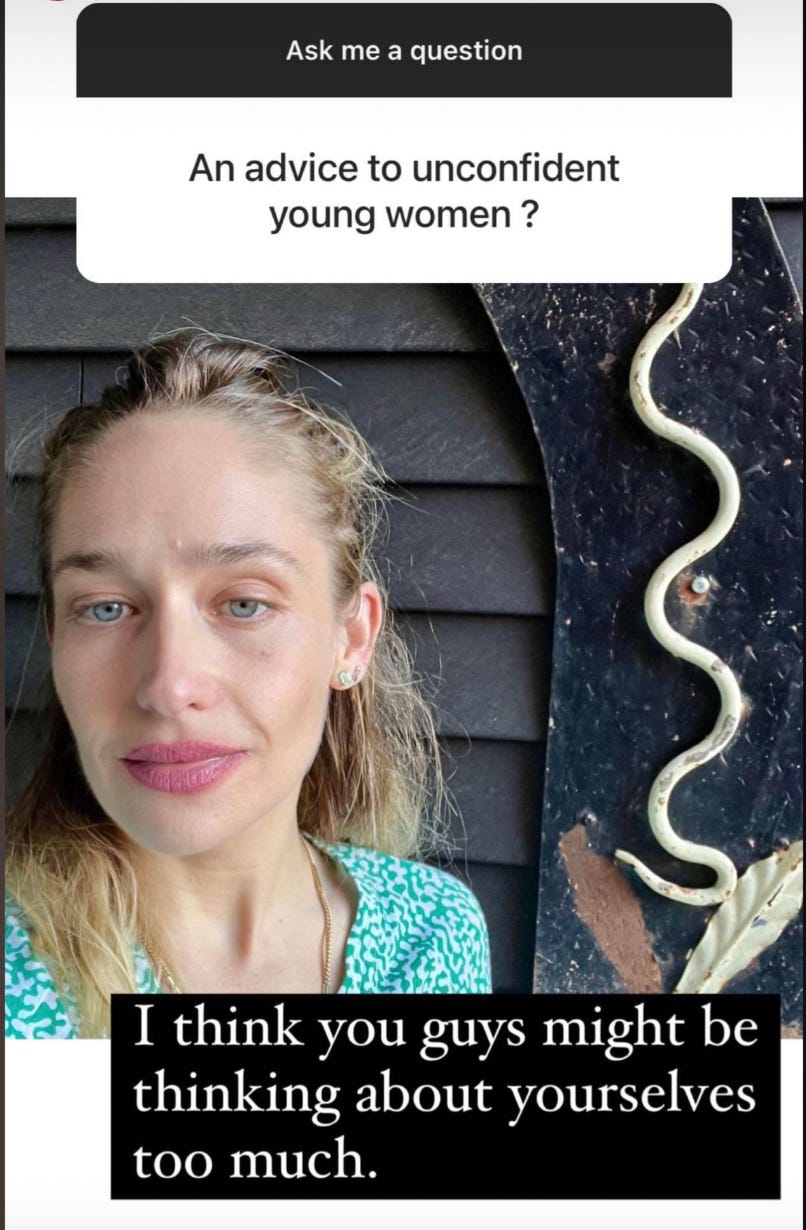
3. See #2: Make the damn thing. Turn off your phone, go for a walk or a drive, and really think about your work. Think about what it is you want to do. Stop making things personal. Zoom out. Find an accountability buddy and focus on benchmarks for completion of a new or old creative project.
4. Learn why you’re insecure. Identify the creative betrayals you’ve experienced in your life and see a therapist or write about the experience. Did you have a teacher tell you they didn’t understand your work? Have you always feared being misunderstood or incoherent? Write about that! You don’t have to share it with the world, but know that unless you work through some of your creative shame, you will continue to haunt others in ways that are unproductive and get you nowhere closer to your goals.
Not Sitting at Tables Where You’re Not Wanted
Creative jealousy can metastasize into a malignancy that destroys artistic communities and individual artists’ concepts of self-worth. If you encounter people who continually seem to throw shade on others or gossip, do your best not to spend time around them, as this behavior can be contagious. It may seem obvious, but also do your best to externalize their behavior. As we’ve discussed above, these words and actions are often the result of emotional immaturity and creative insecurity.
When embarking on a creative project that may require intense collaboration, choose wisely. Have conversations and get to know your collaborators well, observe them in the wild and in common social spaces, in real life or otherwise. Ask them questions about their creative practice and how they like to work with others. Ask them about a recent community member’s work and see how they respond. Do they offer critiques that are rooted in the artistic practice or output, or do they eventually fall to ad hominem attacks? Try not to occupy spaces where the goal is to gossip and not get the work done.
Lastly, art-and-meaning-making are practices often done in a solitary fashion. The work is often thankless or unrecognized, and yet we still endeavor toward it. If you are asked and can offer constructive feedback, provide it. If you appreciate a work of art, essay, song, poem, or short story, tell the creator. It matters more than you think.
*The original title of this essay was Try not to be a petty little bitch: On the virus of haters, naysayers, and hoarders of social capital, and while I eventually decided to take the spice level down a little, the sentiment remains.