and maybe it did the same to you too
Let’s back up: I almost called this piece ‘How I Let the Internet Turn Me Mean,’ but that felt clunky. The sentiment stands, though—with ‘let’ being the operative word. I’ve had to learn over time that things don’t just happen to me – I am a participant in life, whether I want to admit that fact or not.
This essay then explores how my personal history and political disillusionment intersected with the dynamics of social media, making me sort of “mean”—and how I’m now working toward reclaiming kindness.
Now that we’ve settled that, let’s look at what I mean by the Internet turning me mean. Some back story:
Early on, like, family of origin early on, I got used to a culture of punishment. I don’t have a ton of fun and carefree moments I can remember from my little-one years. Getting sick was seen as an inconvenience to my caretaker, so was learning how to spell and speak correctly. Little things were added up into a calculus of general disregard and sometimes outright mockery and cruelty. I bring this up because my later “meanness” was easier to cultivate because it was mostly all I knew. I had at least one really great adult who entered my life in my early teens, and his presence, nay, some would say his intervention, pretty much saved my life (thanks, Mehdi!).
That said, a lot of my vulnerabilities (and maybe yours too) started at an early age. I am hardcoded to be vigilant, to detect even a whiff of rejection and critique. In some of the small, activated shards of my raddled brain, I still have reactions that could be tempered, thought through, but also given some grace. This still wounded part of me made me easily persuadeable in my future political activism and presence online.
My Entrance and Exit from Political Organizing
I watched Occupy Wall Street unfold from a laptop, overseas. I came back to the States invigorated and interested in engaging in the politics of the day. At my university, I became close friends with a woman who was part of the campus branch of the International Socialist Organization. In less than a year I undertook deep learning—of history, of social movements, and political organizing tactics and theory. I worked hard to develop my political acumen and wherewithal. I went to the national convention in Chicago with my comrades. I marched, showed up, protested.
After years of reading and thinking critically on my own, I had found a new political organization to call home.
Once I felt more comfortable and called upon to strengthen my leadership skills, I worked to build a faction dedicated to women’s liberation. We had a few short meetings to figure out our reading and action items before the leadership team figured out I was serious. Unfortunately, the ISO was allergic to anything that smelled of “identity politics” and the steering committee, composed of at least two people who were having a romantic relationship decided that my efforts at creating such a group should not be allowed. This betrayal led to me leave the organization. I was further disillusioned when the organization (national and international) disbanded due to the egregious mishandling of sexual misconduct within the Portland branch (my home branch).
I was now politically “homeless”.
The ISO had taught me to dismiss ‘politics as usual,’ making it hard to engage with groups seen as ‘liberal’ or insufficiently revolutionary. I felt like I had nowhere to go. Nowhere that truly understood and encouraged a collective effort towards women’s liberation, towards freedom from harm for Black people just trying to live, freedom for workers to unionize and empowered without the baggage of purity politics. I felt utterly hopeless.
This hopelessness led me to the one place it seemed people were still engaging politics — the Internet. This was shortly after the Arab Spring, where we had a still blind hope that the revolution could be televised. This era of Internet activism made many aspiring world-changers believe that things could change through dedicated online efforts – pressure and public shaming of officials — from low-level city council members to presidents of nations.
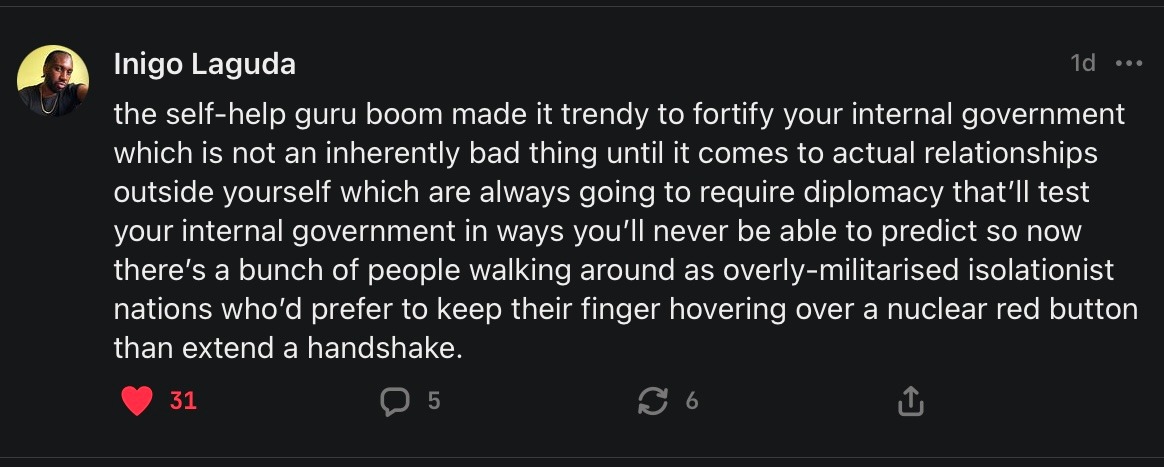
Unfortunately, this instinct to “name and shame” those in power translated to policing our peers. Using the tools and language of the activist left, huge swaths of politically under-developed and unanchored people took to social media to critique, pick-apart and psychically annihilate each other. This supposedly well-intentioned instinct, paired perfectly with pop-psychology trends around concepts such as trauma, cPTSD, boundaries and more has since been weaponized to carry out kangaroo courts, end friendships, and destroy free and authentic expression.*
The reasons for this sort of behavior amongst myself, my peers and everyone else on the Internet are vast, but at the top of my list are the following conditions that led to this behavior:
Lack of third spaces, free from commerce, and where people could gather freely to organically discuss and organize over shared interests and problems
Profound alienation from the fruits of our labor and a commodification of social relationships
An increase in discomfort around conflict and dialogue
Lack of local political development and organizations to join
Increasing disenchantment with voting as the only political action one could take
Loneliness and a desire to be heard
For many of us, online spaces, specifically social media, gave us what felt like a “voice”. On our stories, posts and comment sections we could communicate in such a way that didn’t really require dialogue. What we said, just was. We could post a meme or stat, feel the waves of admiration from our peers pour in, and be done with it. This “worked” for a few years. To a point.
Our offline disempowerment has only spilled into online spaces, where dehumanizing behavior—toward loved ones and strangers became normalized. Social media as a medium by which we communicate with others is structured such that long form thought, in-depth analysis and sustained and thoughtful conflict is nearly impossible. As a result, political and psychological polarization has run rampant.
This essay is in part, an acknowledgement of my part in this process. I felt alienated in so many ways after leaving political activism. Many of the friends I made during that period stayed with the ISO, so online connection increased rapidly for me. Throughout election cycles I somehow believed that monologues and hot takes on social networks would get others to see my point of view. I built a wall up against others who I perceived as Democratic Party shills…out of touch and uncaring about what real people needed.
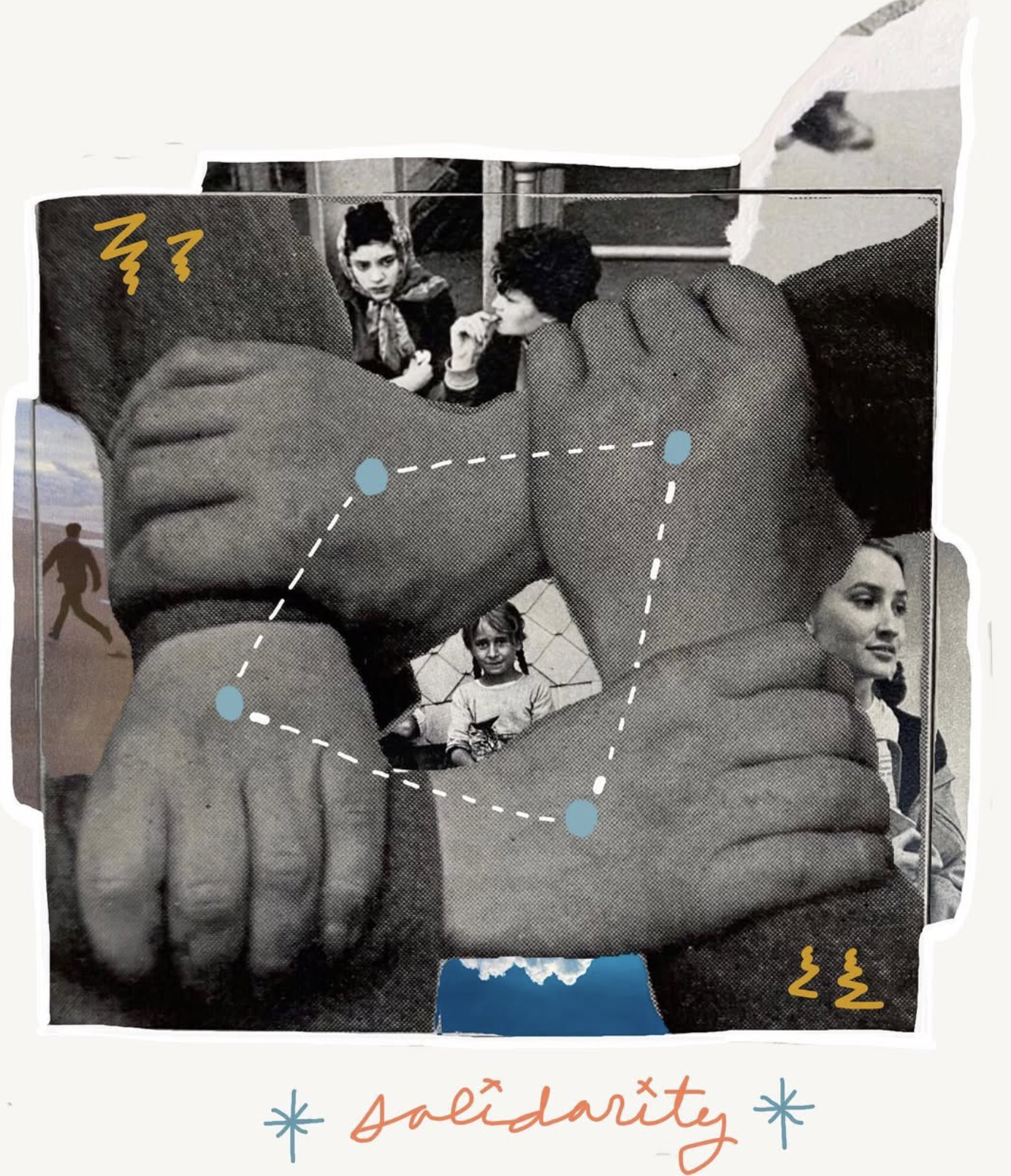
I still need to work on this (and so does the Democratic Party for that matter), but what I’ve found is that having real conversations — in person or on the phone is the best way to see where your differences and similarities with another person lie. In doing so, we can know where we stand, and perhaps how we can stand united against a ruling class that would buckle under the immense pressure of our solidarity. A solidarity forged over sustained connection, where our humanity can’t help but be seen and acknowledged.
Once you’ve tasted this kind of connection you get to a point where you’re emotionally over the Internet. I know I am.
I’m over the critical masses with minimal impact and precipitous falls back towards earth. I’m tired of the only form of emotional expression coming from memes. I’m sick of hot takes and the poisoning of grassroots social movements (the call sometimes comes from inside the house on that one!). I want us to step away from the quick answers to a repeated examination of the conditions we find ourselves in, and how that might lead us away from our humanness and towards a cold, potentially violent future. We can do better.
Turning Towards Kindness
So, how do we move forward?
A major shift in how we exist online has been in the works over the past few years. People of all ages are starting to reexamine their relationship with their phones, with social media and the Internet in general. There is some anecdotal evidence that people are leaving social media, but is it enough?
Once offline, who are we? This mostly sounds like a rhetorical question, but so many of us are entrenched in the dramas, ebbs and flows of the platforms we frequent. Platforms that, if we think long and hard about, do not care about us. So, as we moved towards a more humane way of being let us take a note from mindfulness and ask ourselves some questions before, during and after we engage social media:
Why am I opening this app? Am I bored, anxious, or sad—and is scrolling really the solution?
How did that just make me feel? Do I feel better or do I feel worse?
What do I actually care about? If getting closer to other people is important to me, is social media helping me achieve that goal?
What about being politically and civically active? Is there a place where I can meet other like-minded people offline to organize collectively?
How can I reflect deeply on the things I can about, and how can I bring nuance to the topics of the day?
Don’t be shy about having this conversation with yourself. Find an anchor and set of values for how you want to move in the world. For instance, I have been working at a Jesuit university for the past five years. I’m not Catholic, and I’m definitely not 100% on board with how the Catholic project has unfolded over the last several hundred years, but I have found that being a mission-based institution, that is having a baseline for good and kind behavior towards oneself and others, is a solid if imperfect model for those of us raised and enculturated in a society that is not always kind or motivated towards the greatest good for all. At my workplace we consider the following:
Care for the whole person and planet, and preferential treatment for the poor
How to utilize discernment when making decisions—leaning on deep listening instead of hot takes or what other think
An emphasis on justice and how we can endeavor towards it thoughtfully
This mission is not perfect and neither are the people, but very often I am in a room with many of my fellow community members and I am left with an awe at the commitment we have towards one another and towards improving the world’s conditions for all.
So, what is that puzzle piece of kindness and thoughtfulness for you? If you don’t have a safe workplace, where can you find ways to ditch the reactivity, get offline, and bring peace to another person’s life?
Have you thought about how to be kinder in the days, weeks, and months ahead? I’d like to know if you think it’s worth it to be kinder in a world that is fraught with deep and sometimes unresolvable problems.
*note: free expression does not mean violence or hate-speech that negatively impacts another person’s wellbeing and mental or physical health